
Message Throughput (TPS)
Message Throughput —TPS, transactions per second— defines how many messages can be processed per second within a delivery workflow. TPS should be understood as a dynamic capacity, ultimately determined by provider limitations and the specific channel being used.
TPS Management in the Platform
The platform controls outbound traffic using the Throttle setting, available when sending an SMS or WhatsApp message from the Summary section.
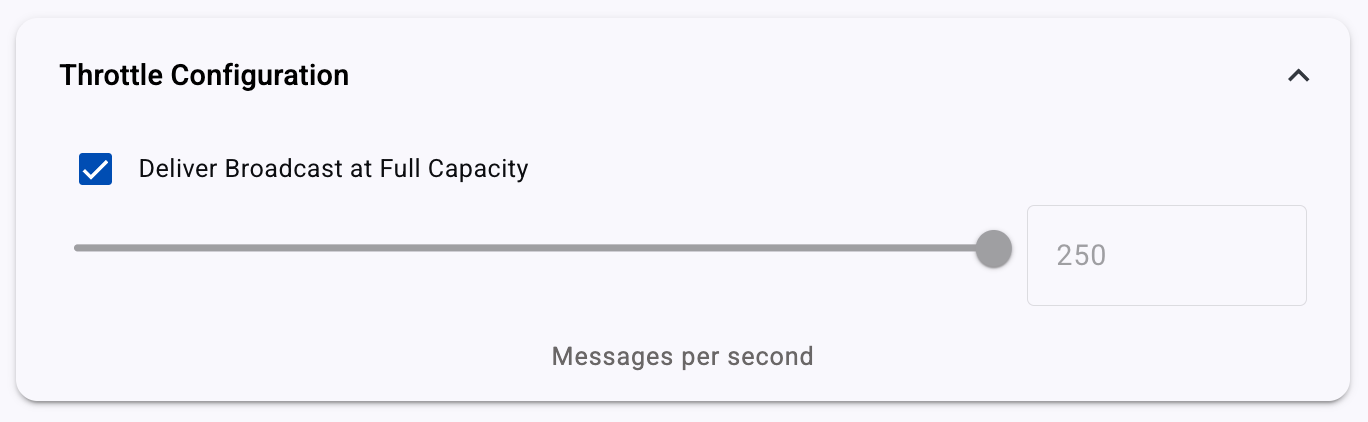
This option defines the maximum number of messages per second that the platform will attempt to send through the selected delivery channel (SMS or WhatsApp).
Throttle acts as an internal ceiling, not as a guarantee of final throughput.
Actual delivery capacity may be lower due to:
- Limitations imposed by providers and operators.
- Channel-level or network conditions outside the platform’s control.
The platform ensures it will not exceed the configured limit, but it cannot increase TPS if the final provider applies stricter restrictions.
API-Level (Rate Limiter)
In addition to the visible Throttle configuration in the platform, the platform applies an API-level rate limit to control the volume of requests entering the system. Both mechanisms follow the same principle: a maximum number of allowed operations per second.
The difference lies solely in where each limit is applied:
-
Throttle (UI):
Used when sending messages through the platform. It controls how many messages per second the system will attempt to process toward SMS or WhatsApp channels. -
Rate limit (API):
Applied when customers integrate directly with the platform APIs. It limits how many requests per second the system can accept from an external integration.
In other words:
Throttle and API rate limiting operate under the same logic.
Throttle governs message throughput when sending from the platform UI, while the API rate limit governs how many incoming requests are accepted when sending via API.
This API limit is internal and cannot be configured through the request body. Its purpose is to maintain platform stability and prevent overload, especially under high-volume traffic.
TPS in SMS
Internal Control
For SMS, Throttle regulates the rate at which the platform will attempt to send messages for delivery. This value defines an internal limit, but does not represent the actual throughput permitted by mobile operators.
Even when selecting full capacity, the final TPS depends on providers and the routing assigned to each country.
Provider Restrictions
Once messages are sent, the effective TPS may vary due to:
- Throughput limits are defined by providers per country or route.
- The maximum message-per-second rate allowed by each mobile operator.
Real example: Some operators in Colombia enforce a 20 TPS limit. Even if the platform is configured to send at a higher rate, the operator will only accept up to 20 TPS.
TPS in Email
Capacity and Shared Limits
For Email delivery, the platform uses Amazon SES as the underlying provider. Throughput is governed by global account limits, which are shared across all contacts and Workspaces.
Current limits:
- 4,000,000 emails per 24-hour period
- 160 emails per second (TPS)
Deliverability Constraints
Beyond raw throughput, email delivery is heavily influenced by sender reputation and list quality.
Providers enforce strict thresholds to protect the ecosystem:
- Bounce rate limit: 5%
- Complaint rate limit: 0.1%
If these thresholds are exceeded, sending may be temporarily blocked or restricted.
The most important factor is that customers must maintain clean and verified email lists. Otherwise, sending activity and sender reputation may be affected once these thresholds are reached, as detailed in the Bounce & Complaint Rates section.
Understanding TPS as a Relative Capacity
The final TPS depends on the most restrictive component in the entire delivery chain. Even if a customer selects full capacity or configures a high Throttle value, actual throughput may be affected by:
- Network traffic conditions
- Channel-specific rules (SMS, WhatsApp, or Email)
- Regional throughput restrictions
For these reasons, TPS should always be interpreted as a relative and variable capacity, dependent on the specific conditions of each channel and provider.
For optimal and stable performance, we recommend operating at up to 50 TPS, especially during continuous or high-volume messaging workflows. This helps ensure consistent delivery even when providers or networks apply temporary throughput variations.
Updated 10 days ago