
Message configuration
Build and customize the message content a contact receives for a broadcast or automation, based on the selected channel. For teams adding templates, personalized fields, and trackable links to a campaign.
You build and customize the messages your audience receives when participating in a broadcast or automation.
Depending on the broadcast you have selected (SMS, Email, RCS, or WhatsApp), you see a tailored message configuration screen with the following options:
- Create or select a message template
- Add personalized fields to customize messages for each recipient
- Insert trackable links to measure engagement
Message Content
In the Message step, you see the option that corresponds to the broadcast you selected. For example, if you selected SMS as your broadcast, you see the configuration section for the SMS message.
You see what types of broadcasts are available for each automation in the table below:

SMS Message
You work with four options to complete the SMS message content:
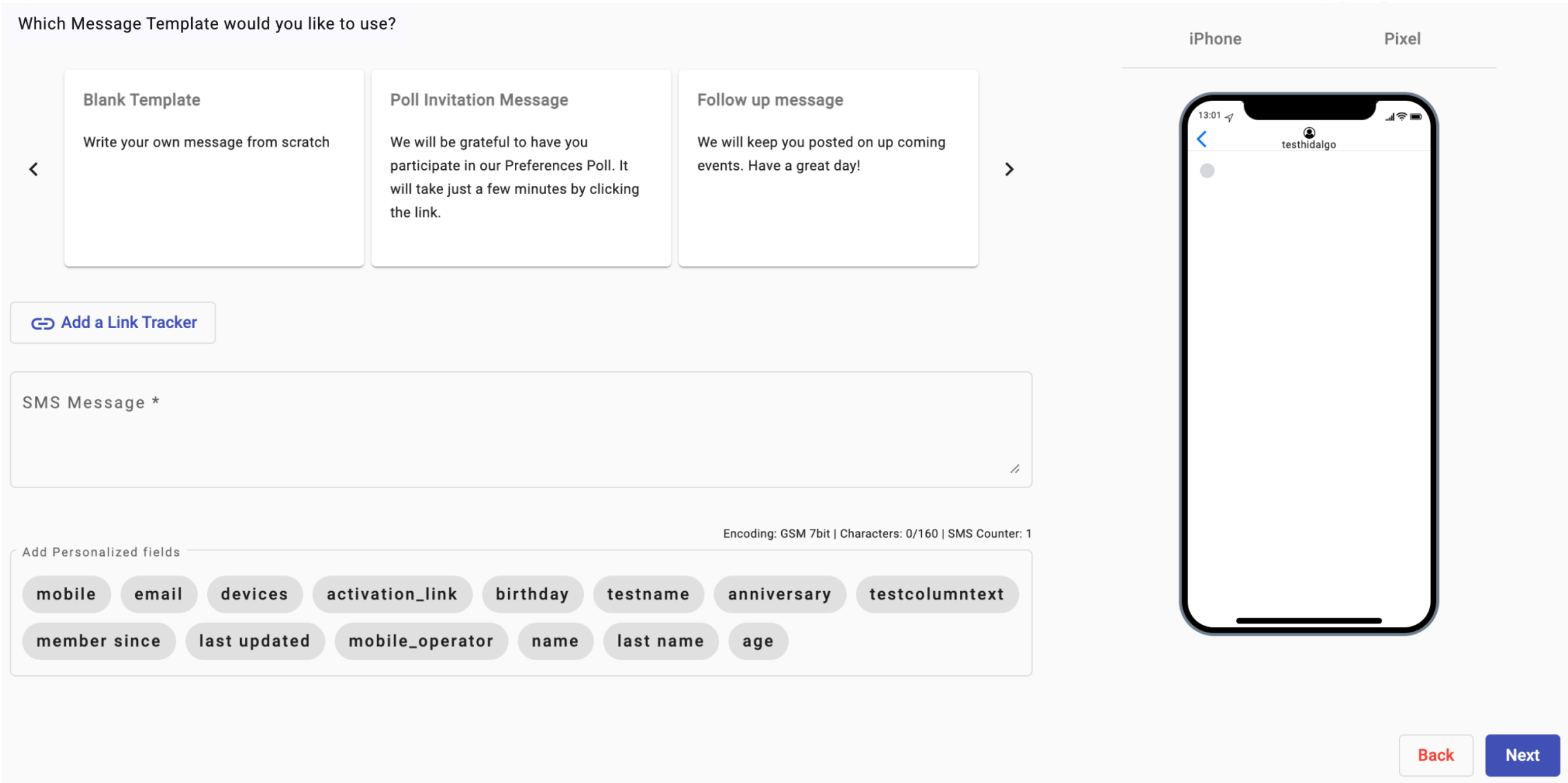
You add and personalize the message content using the following steps:
- Select one of the previously created message templates at the top of the panel or create a new message.
- Add a Link Tracker (optional). Add a URL that recipients tap for a redirect. For more information, go to the Link Tracker section.
- Type the message directly into the SMS Message box.
ABOUT THE MESSAGE STRUCTURE
In the lower section of the SMS Message box, it shows the message GSM 7 bit encoding format, a character counter, and number of messages to be sent to each recipient using the message that was entered, including the text of the personalized field. So you must be vigilant that the current max length to enter the message content is 160 characters. If the message content contains a total of 170 characters, the message will be segment and the broadcast will deliver 2 messages to each Recipient. That is, every time the total number of characters is exceeded, the SMS counter will be incremented.
- Add Personalized Fields (Placeholders). Add placeholders in the message content to personalize each message. For more information, go to the Message Personalization section.
RCS Message
You work with three options to complete the RCS message content:
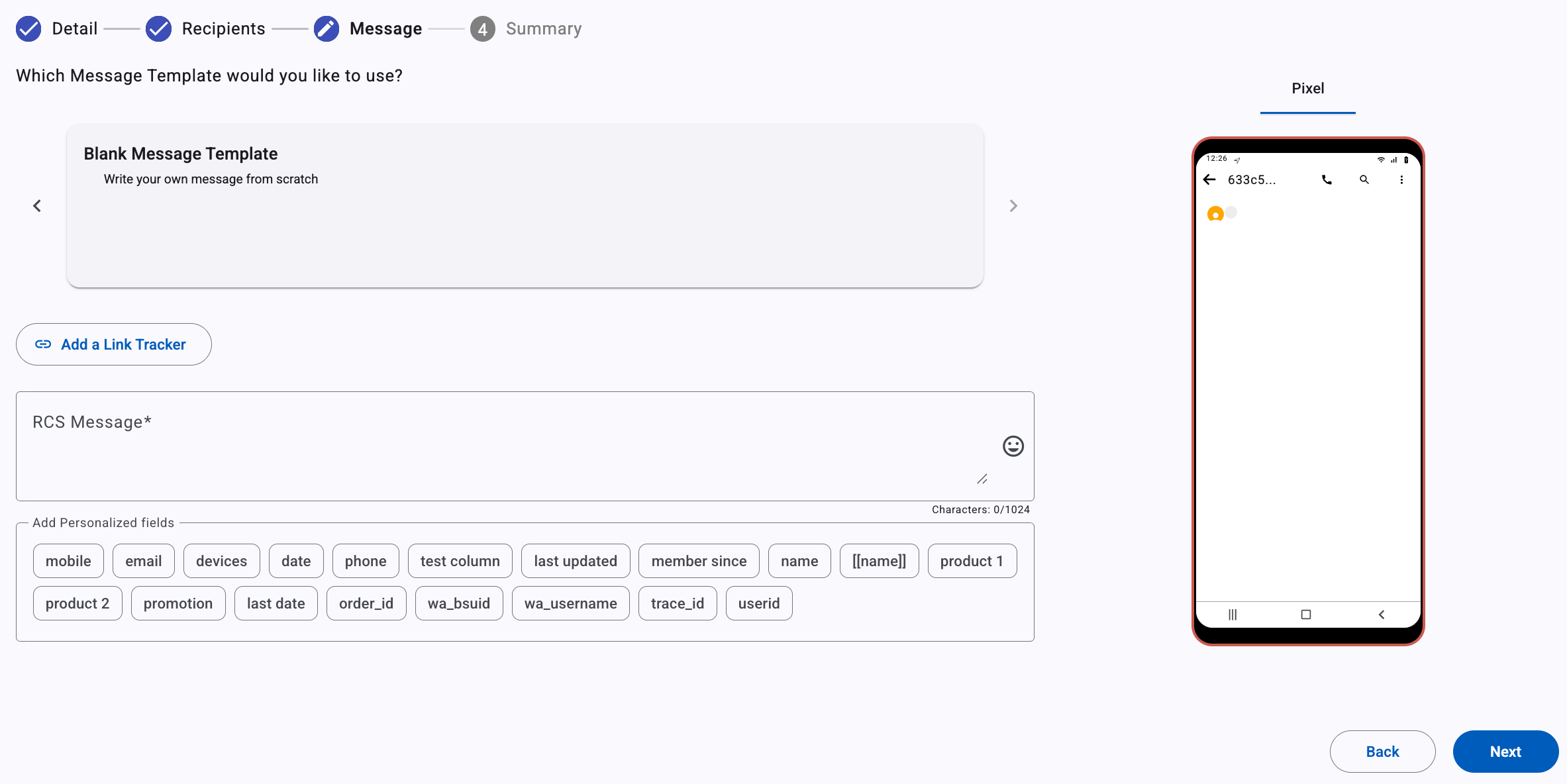
You add and personalize the message content using the following steps:
- Select one of the predefined message templates at the top of the panel.
- Add a Link Tracker button to insert URLs that recipients select for further actions. For more information, go to the Link Tracker section.
- Type the message directly into the RCS Message box. The maximum number of characters is 1024.
- Add personalized fields using placeholders in the message content. For more information, go to the Personalized Fields/Placeholders section.
Message Personalization
You personalize messages using placeholders that are dynamically replaced with contact data. Default fields cannot be deleted or modified.
Default fields include the following:
- Mobile
- Devices
- Last updated
- Member since
How you add personalized fields to a message depends on the delivery method used in the broadcast.
SMS / RCS
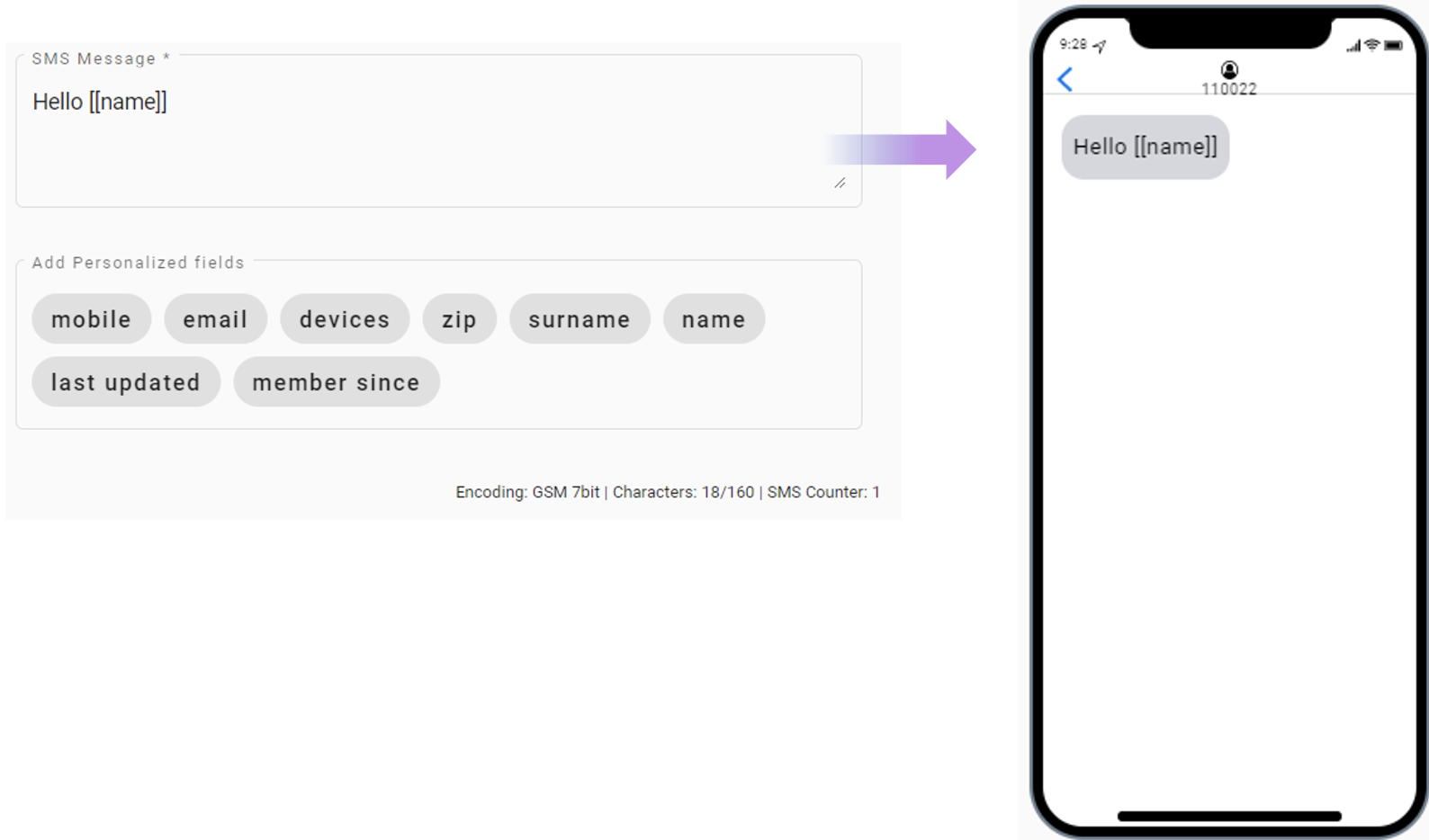
To send a personalized SMS or RCS message, you type "Hello" in the message box. You then select the name placeholder from the Add Personalized Fields box to add the contact's name after the greeting.
The personalized field appears in the message box as [[name]], surrounded by square brackets. When the message is sent, "[[name]]" is replaced with the contact name.
Email
You create the email content with personalized fields for each recipient using the Personalize block.
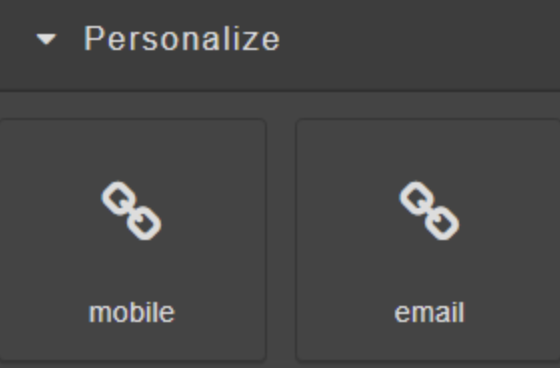
When you select the Personalize drop menu, you see the available fields from the Contact List Fields.
If you drop the Name field into the email, recipients receive the email with the name value from the Contact List Field.
WhatsApp
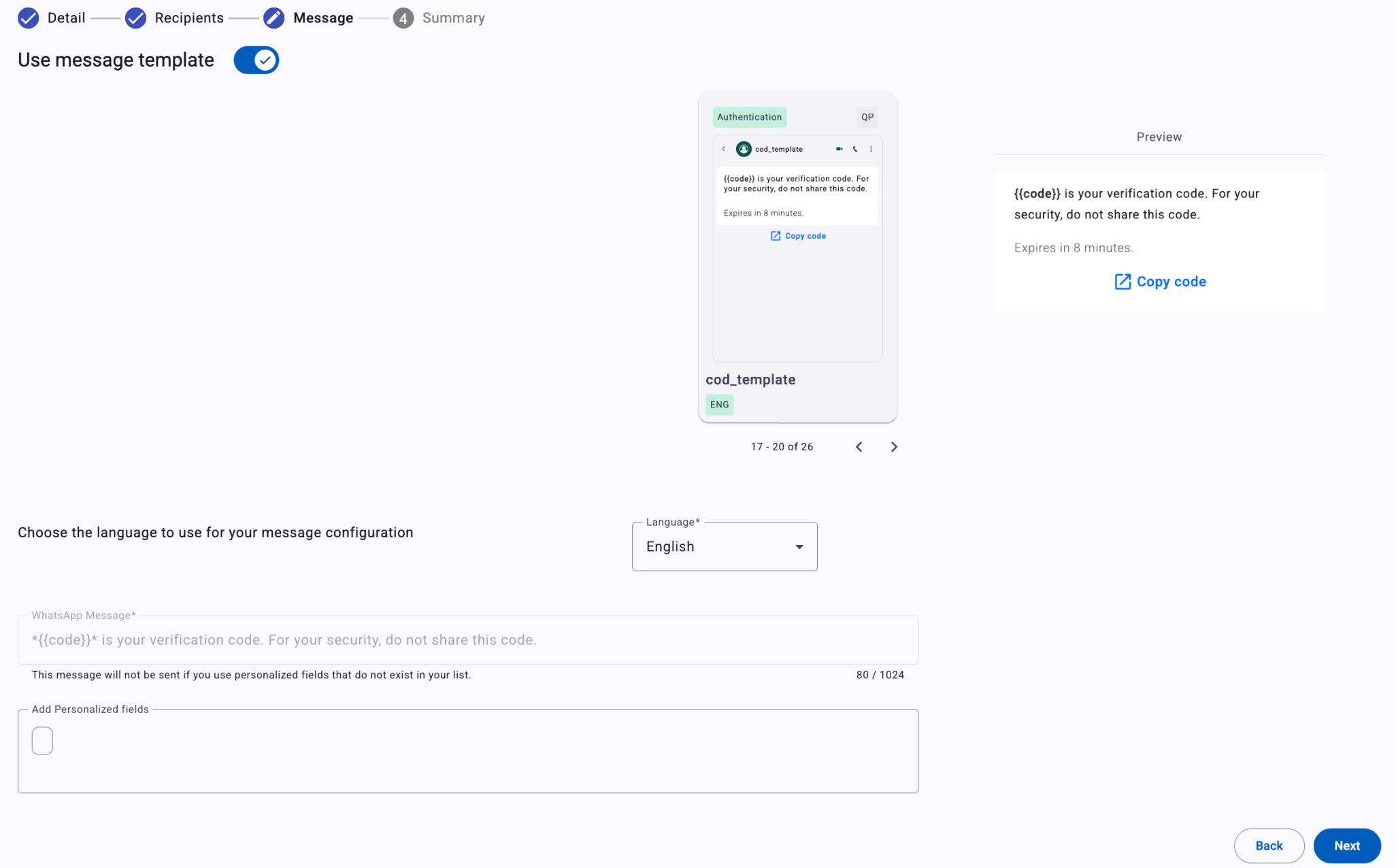
Verify that the contact attributes include the values of the fields used in the selected message template. If you use the "cod_template" message template, the contact attributes must include the value of the {{code}} field.
Link Tracker
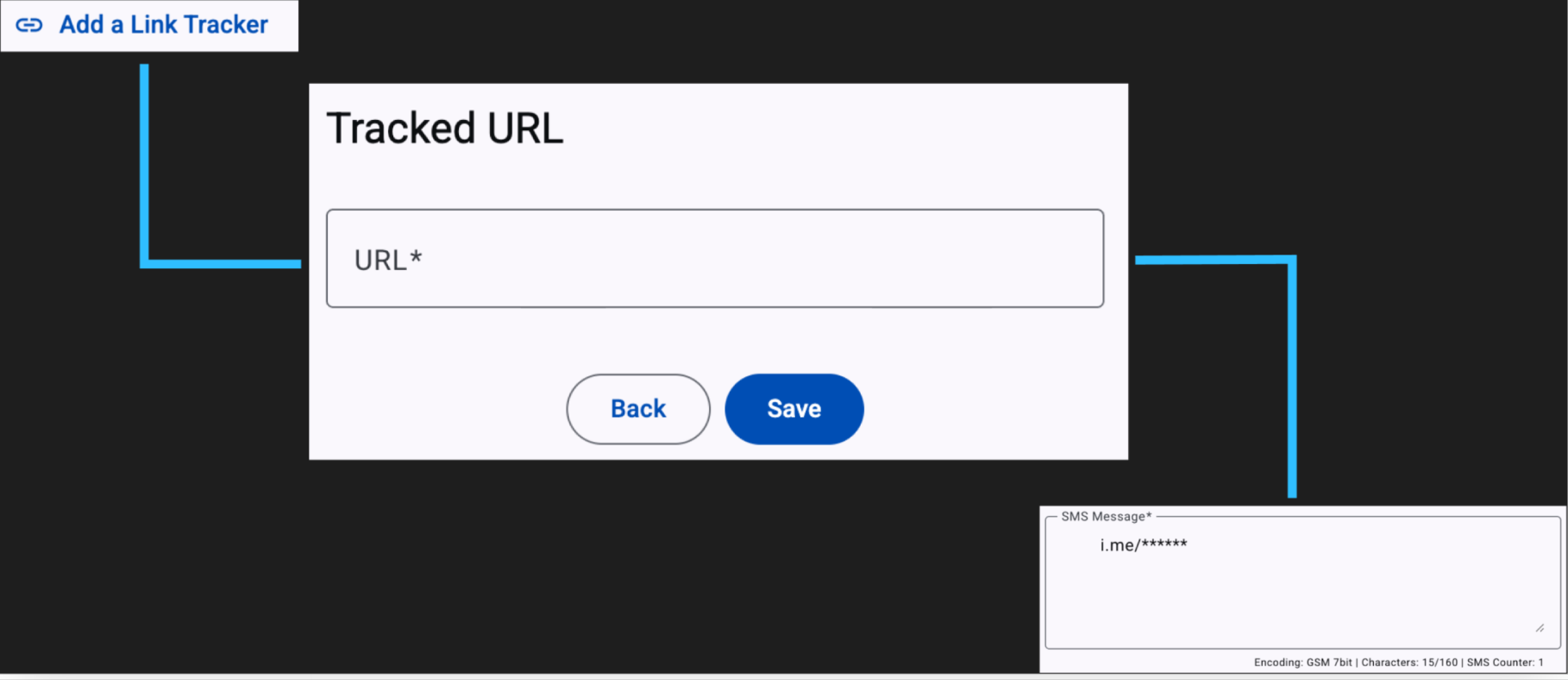
You use Add a Link Tracker to insert a URL that recipients select for further actions. You apply this feature in SMS, RCS, and Email broadcasts.
After you enter the link name and URL into the dialog box, you select the Save button. Shortened URLs appear at the next available position in the message box.
You bind your own branded domain or sub-domain to use the URL Shortener, or you use the default domain msgi.me. You configure a custom-branded domain for use in short links generated via the API.
You use a custom-branded domain in SMS, Email, and RCS broadcasts where recognizable links improve click-through rates.
By default, all short URLs use the domain msgi.me. You request a custom domain if your branding requires it. A custom domain aligns your messaging experience with your corporate identity.
Using a custom-branded domain provides the following advantages:
- Enhanced brand recognition across communications.
- Increased credibility through a familiar and trusted URL structure.
- Higher click-through rates, as end users interact more with recognizable links.
URL Shortener ExpirationBy default, every short URL created through the Link Tracker remains active for 1 year from its creation date. After this period, the short URL expires and no longer redirects users to the destination URL.
You initiate the custom URL shortener setup by submitting a request. After the team receives your request, they share a selection of available domain options for you to choose from.
When you opt to use a domain you already own, two limitations apply:
-
No Subdomain Assignment — You are not able to assign unique subdomains to your customers. You and all your users access the platform using the same shared URL.
-
No Per-Workspace Branding — You are not able to apply different logos or icons for each customer Workspace. You and all your customers see the same branding across the platform.
Example:
- Provided Domain:
mydomain.com - Shared Access URL:
cpass.mydomain.com(applies to all your customers)
NOTEOnly one custom domain can be assigned per owner.
If you want to use your own branded domain (Custom Domain), please reach out to your Account Manager or Support Team for further assistance.
WARNINGBefore entering the URL that will be trackable, if the configured URL has a distinct
".com"domain extension, iOS end users (iPhone) will not be able to click on the URL shortener. Therefore, we recommend placing a secure hypertext transfer protocol"https://"at the beginning of the domain.
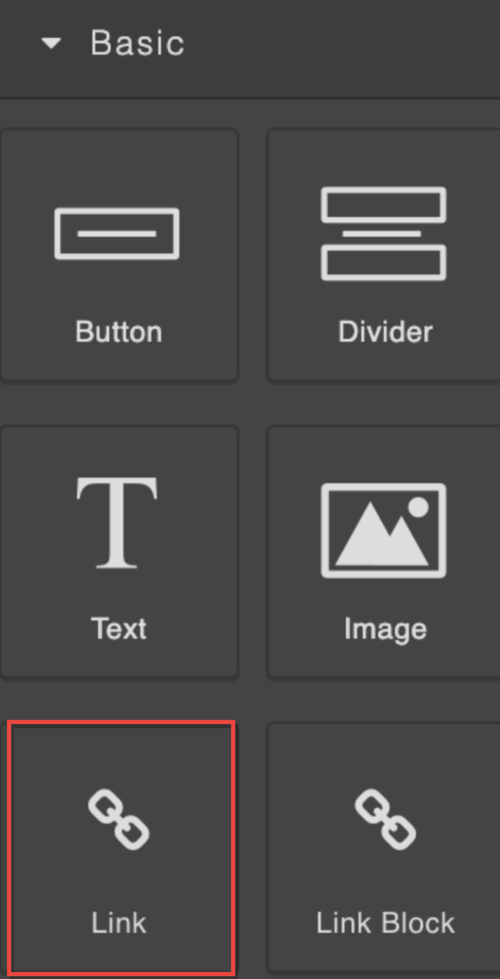
You create the email content with trackable links using the Basic Blocks by selecting the Link Block.
Updated about 2 months ago